Pencil in the Margin: A Garden Almanac and the Weather We Actually Lived Through
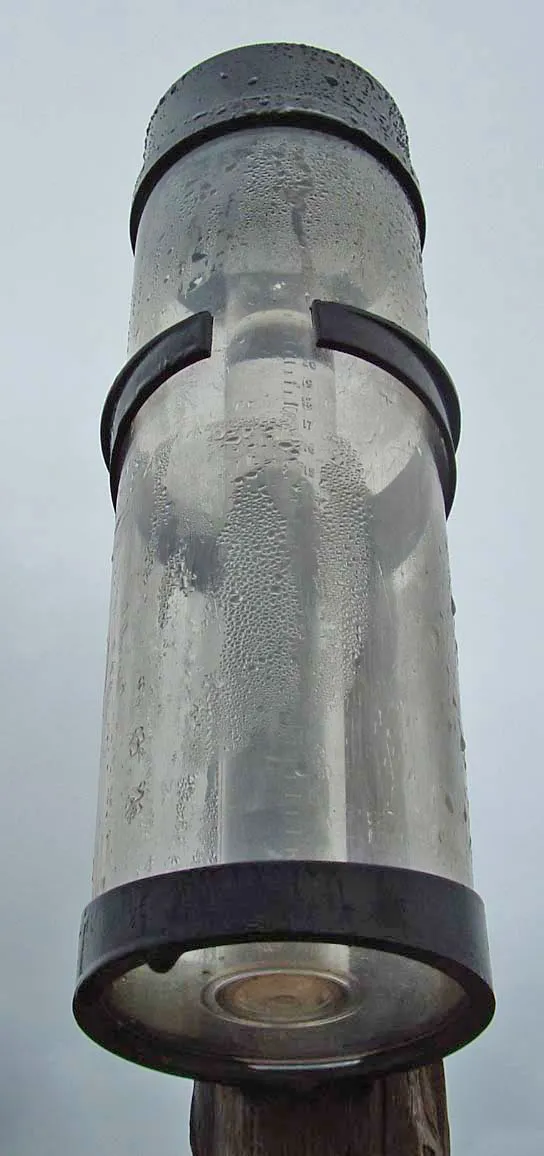
Photo: Bidgee, CC BY 3.0, via Wikimedia Commons
Among the rhubarb, where the leaves make a canopy and the stems push up red and unreasonable, a rain gauge is an unlikely monument. It is not a scientific instrument in any formal sense. It is a domestic one: a plastic funnel, a measuring cylinder, a bracket screwed to a post. Yet for the gardener who kept it there, it was the beginning of a record. The gauge was read, the figure was written down, and the almanac in the kitchen drawer became something more than a book of tables. It became a ledger of weather as it was actually lived, in one UK backyard, across a run of years.
The document itself is unremarkable to look at. A slim almanac, perhaps a gardening edition, with printed calendars, moon phases, sowing charts and advertisements for seed merchants. But in the margins and across the blank pages at the back, a second text has accumulated. Rainfall totals in pencil. Frost dates in biro. Notes that begin as measurements and end as complaints, observations or small pieces of hope. Read together, they form an unofficial meteorological archive: partial, idiosyncratic and quietly valuable.
The Instrument in Place
A rain gauge in a garden is always in the wrong place and always in the right one. Official weather stations seek open ground, standard heights and freedom from shelter. A garden cannot offer that. The gauge among the rhubarb sits under the influence of a shed, a hedge, a wall, the broad leaves themselves. It may be splashed by a downpipe or shadowed by a fence. Its readings are not comparable, in any strict sense, with those from a nearby station.
But that is precisely what makes the garden diary interesting. It records weather as it arrived in a particular place, with all the obstructions and microclimates that make a backyard different from a field. The rhubarb bed may be sheltered from a north wind; the runner beans may catch the first frost. The gauge does not measure the climate of a region. It measures the climate of a garden, which is a smaller and more intimate thing.
The Almanac as Register
The almanac's printed pages provide the skeleton. Dates, seasons, expected last frosts, suggested sowing windows. The handwritten additions provide the flesh. A column headed simply Rain, with figures in inches or millimetres. A note beside a date: frost, 12 May, beans blackened. A line in June: rhubarb drowned, three inches in two days. A tick beside a sowing and, weeks later, a word about germination.
The register is not systematic. Some years are fuller than others. A holiday leaves a gap. A broken gauge produces a note rather than a number. The gardener's hand changes over time, as hands do. Yet the irregularity is part of the record. It shows attention rather than automation. Each entry required a person to walk outside, look at a cylinder, and decide that the figure was worth writing down.
What the Columns Cannot Say
The diary cannot tell us everything. It cannot tell us the exact temperature at noon, the wind speed, the humidity. It cannot be used to construct a rigorous series. Its measurements are affected by siting, by instrument changes, by the gardener's own habits. A gap in July may mean drought, absence, or simply a lost pencil.
Those limits should be acknowledged rather than smoothed away. An archive practice worth the name does not pretend that a domestic record is an official one. It asks instead what kind of evidence the record offers. Here the evidence is qualitative as much as quantitative. The figure of three inches in two days is a measurement; the word drowned is an interpretation. Together they preserve an event that a table of monthly totals would flatten.
The Climate of Small Events
Official records are good at averages and trends. A garden diary is good at incidents. The late frost that caught the potatoes. The long dry spell when the water butt ran low. The summer that never quite arrived. The spring when the rhubarb came early and then sulked. These are not climatic abstractions; they are events with consequences, remembered in relation to a particular crop, a particular bed, a particular week.
In a UK context, where weather is often described as changeable rather than extreme, such small events matter. A fortnight of rain in June can be a nuisance in a national summary and a disaster in a garden. A single frost date can determine whether a household has beans in August. The diary holds that scale of experience. It is not a dataset; it is a memory with numbers in it.
Why It Still Matters in 2026
In 2026, much weather information arrives automatically. Apps deliver forecasts and summaries; devices log temperatures without being asked. Against that background, a handwritten almanac might seem merely quaint. But the value of such a record is not its efficiency. It is its proximity. It documents what one person noticed, in one place, over time.
For archive practice, the lesson is straightforward. Ordinary records deserve care. A garden diary can be photographed, transcribed and stored alongside other family papers. Its context should be noted: where the gauge stood, what was grown nearby, who kept the record and for how long. Those details turn a sequence of figures into a document with meaning.
The rain gauge among the rhubarb will not settle any scientific question on its own. It was never meant to. It was meant to help a gardener decide when to water, when to sow, when to cover a row. But in doing that, it also produced a record of weather as it was felt and acted upon. That is a modest kind of archive, and a durable one. The pencil marks in the margin remain legible, and the weather they describe remains, in its small way, ours.