Sticky Evidence: The Silent Chronicles of a Preserving Shelf
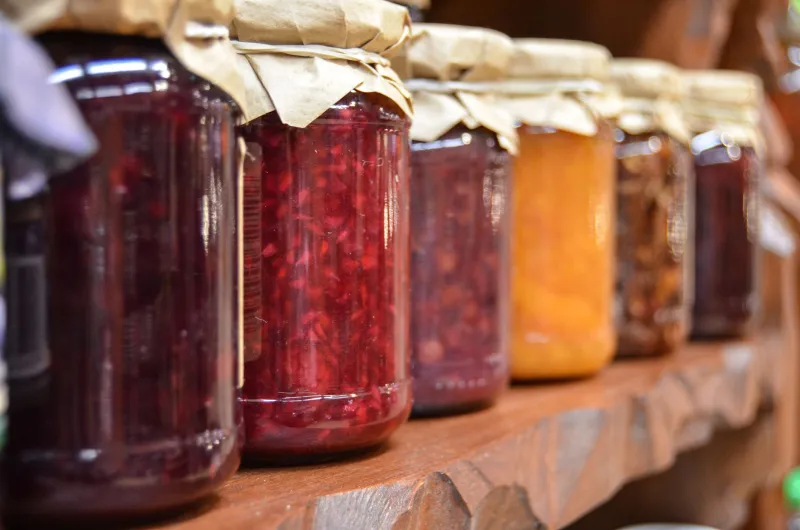
Among the more modest documents in a household archive, the handwritten preserve label has an unusual advantage: it is made at the moment of work, by the person who did the work, and then fixed to the object it describes. It is not a retrospective account, tidied for an audience. It is a note written while the pan is still cooling, the jars are still hot, and the kitchen smells of fruit, sugar and steam. That immediacy gives it a particular kind of value.
A preserving shelf is not simply a place where food is stored. It is a small record of the year: what ripened, what was given away, what was bought in quantity, what needed using up. The labels on the jars—often no more than a strip of masking tape or a salvaged sticky label—form an unexpectedly rich archive of domestic life in the United Kingdom. They are modest, imperfect and frequently illegible. They are also evidence.
A label written at the point of use
Most preserve labels are not designed to last. They are written with whatever pen is nearest, stuck to whatever jar is clean, and dated only because the maker knows that time matters. The information is practical: fruit, year, sometimes month, occasionally the source of the fruit or the name of the person for whom the jar is intended. Yet the very ordinariness of these notes is what makes them useful. They are not written for posterity. They are written so that a household does not confuse one dark jar with another, and so that a gift can be identified later.
In archival terms, this is a form of incidental record-keeping. The label is not created to document a life; it is created to manage a shelf. But the effect is documentary all the same. A jar marked “Damson, Oct 2023, hedge behind chapel” carries more than a date. It carries a place, a season and a set of assumptions about what was available and worth gathering. A label reading “Marmalade 2026—Seville, from Mr Patel” records not only a fruit but a transaction, however informal.
Seasons, surpluses and the local economy of jars
Preserving is often described as thrift, but it is also a way of managing abundance. The glut is a familiar feature of British domestic life: the courgettes that arrive all at once, the apples from a neighbour’s tree, the blackcurrants that must be picked before the birds take them. The preserve label is the point at which that abundance becomes a manageable unit. It turns a bucket of fruit into jars that can be stored, given, swapped or opened in January.
Read a shelf of labels together and a seasonal pattern emerges. Early summer may bring strawberry and gooseberry; late summer, plum and blackberry; autumn, apple and quince; winter, marmalade made with Seville oranges. The labels do not need to be beautiful to be informative. A row of jars marked “Blackberry 2024”, “Blackberry 2025” and “Blackberry 2026” is a small chronicle of weather, foraging and inclination. One year may have produced enough for six jars; another, only two. The label cannot explain the difference, but it can register it.
There is also a local economy here. Preserves move between people in a way that is rarely counted but widely understood. A jar is returned, refilled, passed on, or given as thanks. The label may carry the maker’s initials, the recipient’s name, or a note such as “for Sunday” or “eat first”. These are not grand inscriptions. They are the small currency of neighbourliness, and they accumulate quietly on shelves and in cupboards across the country.
What the label cannot say
The preserve label is not an impartial document. It records what the maker chose to write, which is often the minimum needed for practical purposes. It seldom records the recipe, the quantity of sugar, the setting point, the pan used or the person who helped. It rarely notes the weather, the cost of the fruit or the reason for making marmalade in a particular week. A label that says “Plum 2024” may conceal a difficult year, a generous crop, a family event or a simple attempt to use up a bag of fruit before it spoiled.
The handwriting itself is evidence of a sort, but it should not be over-read. A hurried scrawl may indicate haste rather than carelessness; a neat label may reflect habit rather than sentiment. Ink fades, adhesive fails and jars are reused. The archive of preserve labels is therefore fragmentary by nature. It is a collection of survivals, not a complete record.
Practical notes for a preserving shelf
For those who wish to keep such a record with a little more care, the principles are simple. Write the fruit, the year and, if known, the source. Use a pen that will not fade quickly, and place the label where it will not be soaked by condensation. If the jar is a gift, add the recipient’s name or the occasion—not for sentiment, but because future readers may need the context. Keep a small notebook in the kitchen if the labels are too cramped; a single line per batch is enough.
None of this need turn the kitchen into a record office. The point is not to make preserving solemn, but to recognise that the labels already perform an archival function. They tell us what was made, when, and sometimes for whom. In a culture that increasingly stores its records in phones and cloud accounts, there is something quietly instructive about a system that relies on a strip of tape and a biro.
A small ledger worth keeping
The preserve label is not a grand document, and it should not be asked to bear more weight than it can. It will not explain a household’s finances, map a family’s friendships or settle the question of what a particular year felt like. But it does something valuable: it fixes a small piece of domestic life to a date and an object. It says that on a certain day, someone stood in a kitchen and made something to last.
In 2026, when so much of daily life is recorded automatically, the handwritten jam label remains deliberately manual. It is a note from one season to another, written in sticky ink and often read only in passing. For anyone interested in the quiet archives of ordinary life, that is reason enough to look twice at the shelf.