The Spool and the Silence: On Keeping a Voice
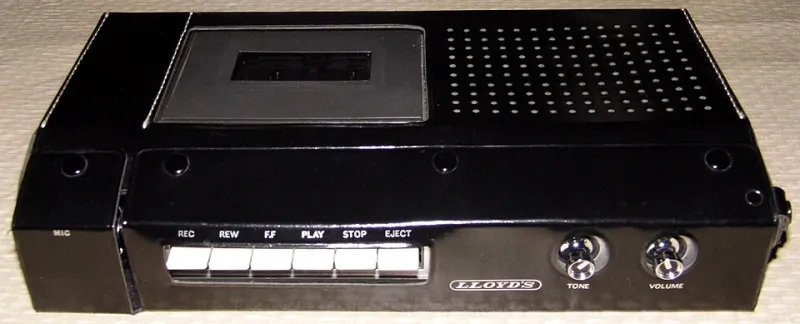
Photo: Joe Haupt from USA, CC BY-SA 2.0, via Wikimedia Commons
The cassette is a Maxell C60, labelled in biro: Answer machine, Dec 94 – Feb 96. It came to me in a shoebox of family papers, and for two years I did not play it. The machine that recorded it is long gone. The tape itself is brittle at the edges, and the pressure pad has begun to lift. When I finally threaded it into a borrowed deck, the first sound was not a voice but the hiss of a medium remembering its own age. Then a voice. My grandmother, asking the caller to leave a message after the tone. She had been dead for eleven years.
A Machine That Remembered for Us
For roughly two decades, from the late 1970s to the early 2000s, the answering machine was the household's interface with absence. It recorded the ordinary: call me back, I'm on the train, just checking you got home. These are not speeches; they are the debris of arrangement. Yet for many families they are the closest thing to a voice archive that exists. The photograph gives you a face. The recording gives you a manner: the breath before a sentence, the accent, the hesitation, the particular way someone said your name.
The Digital Switchover and the Vanishing Spool
Voicemail replaced the machine, and voicemail is stored on servers, often deleted after thirty days by default. The digital answering service is convenient and forgetful. In the UK, the retirement of the analogue public switched telephone network—Openreach intends to complete the move by the end of January 2027, and as of 2026 the migration is well advanced—means that many households have already unplugged the old machine and left the tape inside. The window for retrieving these tapes is not closing slowly. It is closing at the speed of a house clearance.
Listening Back: Grief, Grammar and Grain
Listening to a dead person's voice is not the same as remembering it. The voice says leave a message in the imperative; the dead do not usually issue instructions. That odd grammar is part of what makes playback so affecting. The recording is not the person, but it is a kind of proof. It can also become a loop, played too often, until the grain wears into a performance. The archive should be a place of return, not a trap.
What to Keep, and How
The practical work is not difficult, but it is time-sensitive. Digitise sooner rather than later, using a working cassette deck and a modest audio interface, recording to WAV rather than MP3. Label each file with names, dates, occasions and speakers. Keep two copies in two locations, and keep the original tape as the master. The British Library's Save Our Sounds programme has made the case for audio preservation at a national scale; the same logic applies in miniature to a family shoebox.
The Ethics of the Playback
A voice message left in 1995 was not left for publication. The family archive is not the same as the public archive, and the difference should be respected. Play the tape for those who knew the speaker; be careful with those who did not. The machine has done its work. The tape is a small, fragile spool of someone's ordinary Tuesday. Keeping it is not sentimentality. It is a form of maintenance—and it can last longer than the machine that caught it, if we begin now.