A Ledger in Wood and Wire: The Case for Counting Repairs
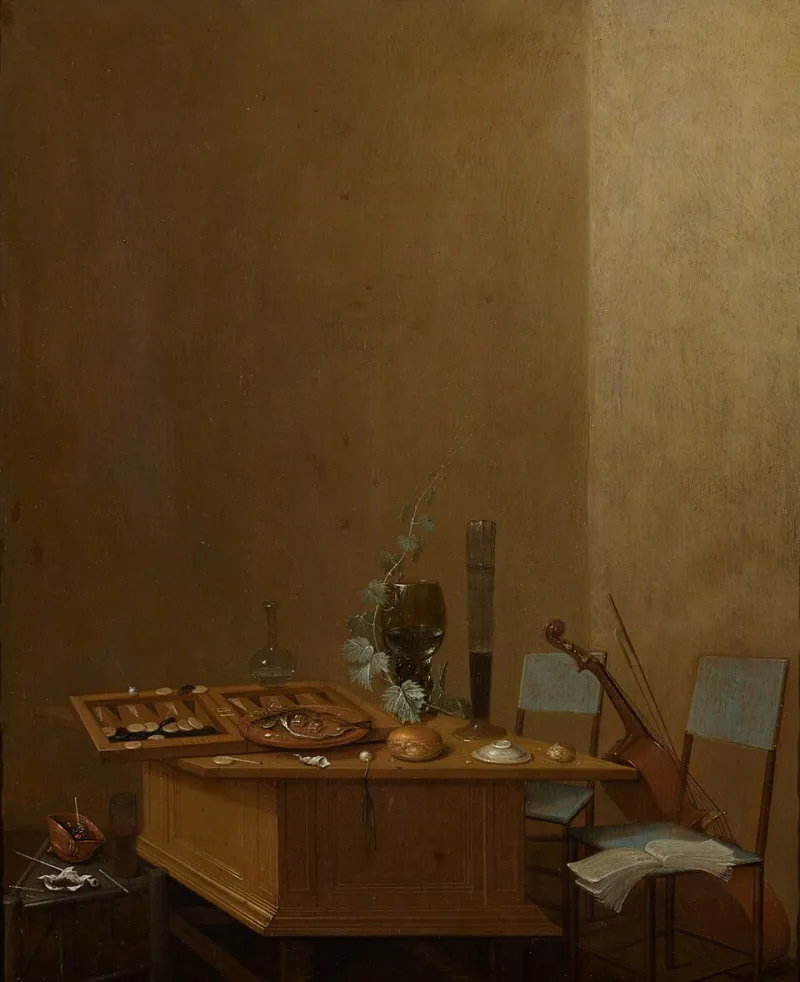
Photo: Gerrit van Vucht, Public domain, via Wikimedia Commons
The chair had been in the family for thirty years before it came to me, and it had spent most of that time in the condition that furniture reaches when it is no longer new but not yet antique: sound in intention, loose in the joint. I noticed the wobble in October. I noticed it again in November. In December I bought a small bottle of wood glue, some clamps and a roll of masking tape, and I made an evening of it.
What I did not expect was that the repair would leave a record. The glue line, once set, was visible as a thin dark seam. The clamps had pressed small dents into the soft wood on either side of the joint. The chair now sits slightly differently, as if it has been annotated. And that, I think, is the beginning of an argument about archives: that the objects we mend carry a ledger of attention, and that this ledger is often more truthful than the one we write down.
The Chair at the Back of the Room
The chair is not valuable. It is a standard mid-century kitchen chair, the kind that was made in large numbers and sold without ceremony. It was bought by my grandparents, moved house at least four times, was painted once and stripped once, and at some point acquired the slight list to the left that I have never quite corrected. A restoration would erase these marks. A repair does not. Restoration aims at the appearance of newness; repair aims at continuance. The distinction matters, because an archive is not a museum. An archive is a place where things are kept usable, or at least kept legible.
What a Repair Café Records
The repair café movement, which began in the Netherlands in 2009 and reached these islands soon afterwards, has made a quiet virtue of the visible mend. In church halls, libraries and community centres, volunteers sit behind tables with soldering irons, screwdrivers and sewing machines, and they do not simply fix; they explain. The Restart Project and the many local repair cafés have built a culture in which the question is not whether something can be replaced but whether it can be kept going. What such a table records is not only the object but the failure mode: the same kettle, the same lamp, the same loose joint. Over time, a repair café becomes an archive of how things break, and of how people learn to notice.
Thrift, Attention and the Long Middle
Thrift is unfashionable when things are cheap and necessary when they are not, but the deeper argument for repair is not economic. It is attentional. To repair something is to look at it for longer than its purchase required. The darned elbow, the rewired lamp, the glued joint: each is a small deposit of time. There is a genre of autobiography that consists of acquisitions—the holiday, the house, the car—but a life is mostly a long middle of maintenance: the boiler service, the rehemmed trousers, the recharged battery. If we kept a ledger of repairs rather than purchases, the shape of a life would look different: less like a series of arrivals, more like a set of continuities.
The Ledger You Cannot Read
A written ledger is useful. I keep one now, in a notebook, with columns for date, object, fault and method. It has entries for a lamp, a door handle, a pair of boots and, of course, the chair. But the object itself is the primary source. The excess glue, the wrong screw, the slightly proud hinge: these are the errata of care. They record not only what was done but who did it, and sometimes who taught them. A repair carries the hand of the repairer. That is why a mended object can feel more personal than an untouched one: it has been handled with intent.
The chair will outlast the repair, and the repair will outlast me. That is not a gloomy thought. It is the ordinary arithmetic of keeping. Maintenance is the truer autobiography because it is distributed: it lives in objects, in habits, in the hands of others. The ledger is not a book. It is a chair, still standing.