Bound in Oilcloth: A Rent Book and the Limits of Administrative Memory
Among the papers that families seldom label and rarely discard is the rent book: a small, stiff-covered booklet, often bound in oilcloth or waxed card, intended to fit a coat pocket or a kitchen drawer. It is not a diary. It has no space for weather, illness or argument. Yet, opened at random, it can read like a life told in weekly instalments.
The Book and Its Conventions
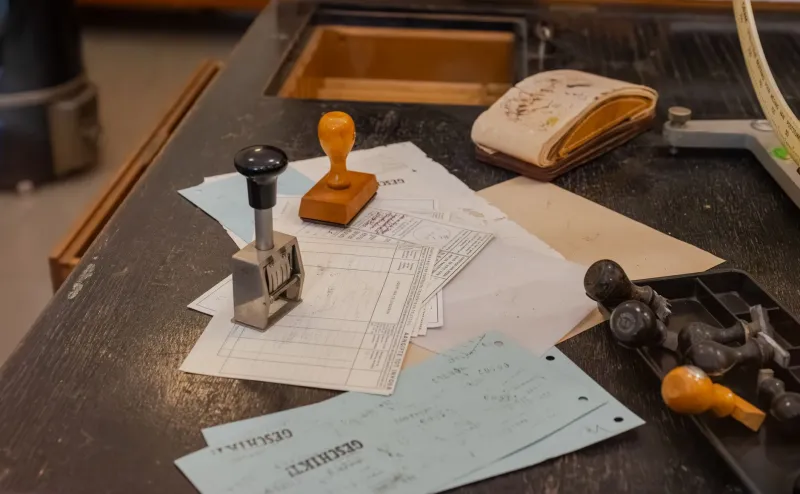
In the United Kingdom the rent book has long been a modest legal instrument, a record of payment kept by landlord and tenant alike. Its printed pages usually ask for the same things: the date, the amount paid, the period covered, any arrears, and a signature or stamp. The landlord's name appears at the front; the tenant's name is written in ink that may now be faded. The format assumes regularity. It assumes a weekly or monthly rhythm, a collector at the door, a receipt made in the presence of both parties. It assumes, in short, that housing is a relationship conducted through paper.
That assumption gives the object its peculiar force. A rent book is not merely a receipt; it is a sequence of small confirmations. Each stamp says that a sum changed hands, but it also says that a bargain was still in force. The book records not only money but the continuation of a tenancy — the quiet fact of remaining in place.
The Rhythm of the Stamp
Read a rent book from beginning to end and the first thing one notices is rhythm. Stamps fall at intervals, neat or crooked, in ink that changes with the collector's pen. A run of consecutive weeks suggests stability, or at least compliance. A gap suggests a missed payment, a holiday, an illness, a dispute, or simply a collector who forgot the book. The printed columns cannot tell the difference. They record the date and the amount; they do not record the reason.
Handwritten increases are especially revealing. A landlord's note — an extra shilling, a revised weekly sum, a new figure entered above the old — turns the page into a small site of negotiation. In the twentieth century such increases might reflect a fair-rent assessment, a change in rates, or the simple assertion of a landlord's advantage. The tenant's response is rarely present. One sees the new amount, perhaps a tenant's initials, perhaps nothing at all. The book shows the outcome of a discussion without preserving the discussion itself.
The Hand in the Margin
The margins are where the rent book becomes less official and more human. Here one finds notes that the printed form did not anticipate: a repair reported, a request to paint, a query about a charge, a reminder that the collector would call on a different day. These annotations are not reliable in any strict sense. They are hurried, abbreviated, sometimes ambiguous. But they show that the rent book was not only a passive record. It was also a place where tenant and landlord communicated in the small spaces the form allowed.
In archive practice, such marginalia are often treated with caution. They are unofficial, undated, and difficult to attribute. Yet they are precisely what makes the object compelling. The printed columns describe a contract; the handwritten additions describe a relationship, however constrained. The rent book becomes a ledger of obligation, but also a record of small adjustments — the kind of adjustments that make a tenancy livable or unlivable.
What the Book Cannot Say
For all its dates and figures, the rent book is a narrow document. It cannot say how many people lived in the rooms behind the door. It cannot say whether the heating worked, whether the walls were damp, or whether the tenant was proud, anxious, or simply tired. It cannot say why a payment was late, or what a tenant sacrificed to make it on time. It cannot say whether the landlord was fair, negligent, or merely distant. The book records payments, not the labour that produced them; it records arrears, not the fear that accompanied them.
This is not a failure of the object. It is a limit that any archive must acknowledge. A rent book is a biography of a tenancy, not of a tenant. It tells us that someone remained in a place and paid for the privilege. It does not tell us what that remaining cost, emotionally or practically. To read it as an autobiography in the fullest sense would be to ask it to speak beyond its means.
Reading It as an Archive
In 2026, when many tenancies are mediated through deposit schemes, digital portals and automated receipts, the rent book can look archaic. Yet its very plainness makes it useful. It reminds us that administrative objects often preserve the skeleton of a life when more personal records have disappeared. The rent book survives because it was required, not because it was treasured. That is precisely why it can be trusted to show the shape of a housing relationship without sentiment.
The task for the archivist is not to inflate the object into a memoir. It is to read it carefully, to note what it records and what it omits, and to let the omissions remain visible. A rent book's stamps may not tell us who the tenant was, but they can tell us how long they stayed, how much they paid, and how often the arrangement was reconsidered. In a country where housing has so often been precarious, that is a quieter kind of autobiography: the autobiography of a threshold, kept in ink.