A Vertical Parish: The Kitchen Door and the Provisional Archive of Everyday Obligations
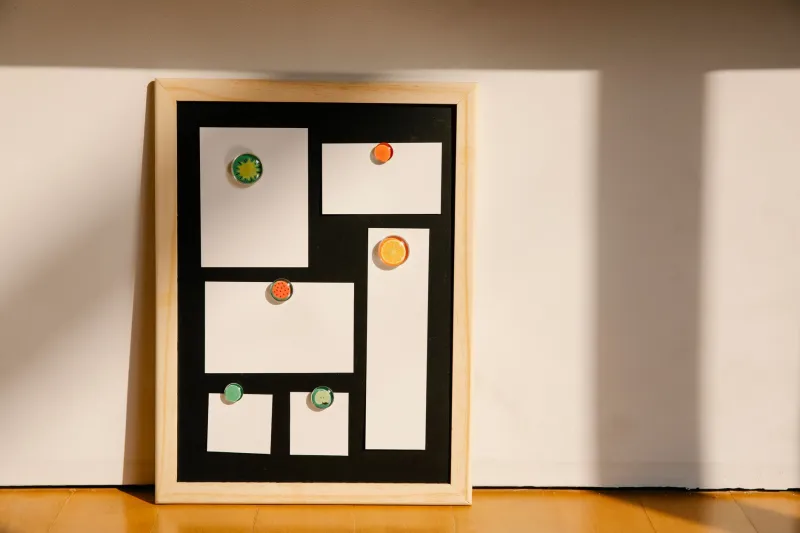
There are archives that announce themselves with boxes, labels and a rule about gloves. There are others that hang in the kitchen and hold up a takeaway menu. The refrigerator door belongs to the second kind. It is a surface of small adhesions: seaside magnets, surgery appointment cards, school timetables, utility stickers, a leaflet for a window cleaner, the recycling calendar that the council delivered before Christmas. None of it was assembled with posterity in mind. That is precisely what makes it worth reading.
In this archive, I have often argued that the most honest records are the ones made for another purpose. The fridge door is a case in point. It is not a diary, a ledger or a photograph album. It is a working noticeboard, and like the parish noticeboard outside a church or village hall, it is provisional, layered and frequently out of date. It tells us less about who a household thinks it is than about what it is currently obliged to do.
The noticeboard without a frame
A parish noticeboard has a frame, a keyholder and an informal hierarchy. The fridge door has magnets. Both surfaces depend on overlap. A dentist's appointment card sits over the corner of a school newsletter; a takeaway menu covers the bottom half of a bin collection notice; a holiday postcard holds down a form that should have been returned in September. The order is not alphabetical or chronological. It is practical, and it changes whenever a hand needs to reach the milk.
The comparison is not merely whimsical. The parish board was once the ordinary place where local information became public: meetings, sales, lost property, civic reminders. The fridge door performs a narrower version of that office within the home. It is where the household's external commitments arrive and wait. It is a threshold register, keeping the street, the school, the surgery and the high street in view while the kettle boils.
Magnets as a map of attachment
The magnets themselves are often dismissed as souvenirs. Read more closely, they form a rough geography of leisure and family connection. A magnet from Whitby, one from Cornwall, another from a museum shop in Edinburgh: these are not records of travel in any systematic sense, but they are coordinates. They mark places that someone in the household once thought worth remembering, or worth bringing home in a small, magnetic form.
The commercial papers are more strictly local. Takeaway menus record the high street as it was at the moment of collection: the Chinese restaurant that delivered within three miles, the Indian takeaway with its handwritten price changes, the fish and chip shop that closed on Mondays. A menu is a document of convenience, but it is also evidence of a local economy. When the shop closes, the menu may stay on the door for months. The household has not yet accepted the revision.
Utility stickers and service labels belong to another layer. A gas safety sticker, a boiler service reminder, a water company leaflet, a council recycling sticker: these are the marks of infrastructure. They are less sentimental than the seaside magnets and more administrative than the menus. Together they show that the fridge door is not one archive but several, fastened to the same steel.
Small obligations and the problem of expiry
The most revealing items are the dated ones. An appointment card for the dental surgery. A school timetable. A reminder about a library book. A party invitation that has outlived the party. These are the household's small obligations, and the fridge door is where they are kept in suspension between arrival and completion.
Unlike a calendar, the door has no grid. It cannot show the shape of a week. It can only show a queue. The result is a form of administrative memory that is candid but unreliable. A card for an appointment in March may still be held by a magnet in November. Is that negligence, sentiment or simply the inertia of a busy kitchen? The door does not say. It records the presence of the obligation, not its resolution.
This is where the fridge door differs from the bound rent book or the annotated timetable. Those records impose a sequence. The door imposes a surface. It is horizontal in its logic even when it is vertical in its position: things arrive, overlap and are occasionally removed. The archive is not the sum of its items but the evidence of their coexistence.
What the door cannot tell us
It would be easy to overread such a surface. The fridge door cannot tell us who placed each item, or why some papers survive and others disappear. It cannot distinguish the urgent from the merely convenient. It cannot give a reliable date for the household's habits. It is not a complete record, and it should not be treated as one.
There is also a question of privacy. A school timetable may reveal a child's routine; an appointment card may reveal a medical visit; a takeaway menu may reveal nothing more than a Friday. Any serious archival treatment of the fridge door would need to begin with discretion. The point is not to publish the household's intimacies but to recognise the kind of record it is: informal, accidental and revealing in aggregate rather than in detail.
A provisional register
In 2026, most of these notices also exist digitally. The appointment is in a phone calendar; the bin day is in an app; the takeaway menu is online. Yet the door persists. It persists because it is visible without being opened, because it holds the household's obligations at eye level, and because a magnet is still the simplest fastener ever devised for a piece of paper that matters for a week.
The fridge door is not the parish church porch, but it performs a similar office. It is a noticeboard for the immediate world: the street, the surgery, the school, the shop, the council. It records a local geography and a set of small obligations with a candour that more formal archives rarely manage. To read it closely is to see the household not as a private refuge but as a small administrative unit, held together by paper, magnet and the ordinary discipline of remembering.