A Line Under the Pint: Doorstep Slips and the Arithmetic of Trust
Photo: Tess Mattew, CC BY-SA 4.0, via Wikimedia Commons
Some archives arrive in boxes; others in a drawer, between the spare keys and the string. The bundle I have been reading is of the second kind: a clutch of milk-round slips, a standing-order mandate from a bank, and a few bottle tops whose foil has been folded back and pencilled with instructions. They were kept, apparently without system, by a household that had no intention of writing history. That is often the best recommendation.
The Drawer and Its Order
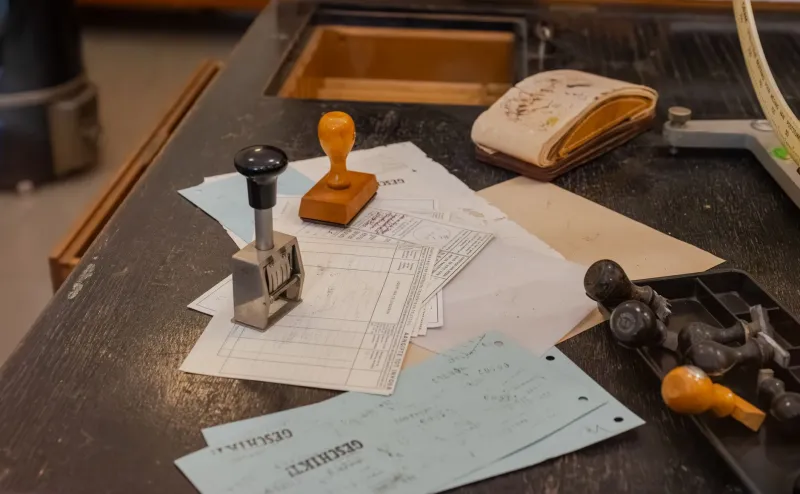
The slips are small, rectangular and printed in a pale blue that has faded to grey. Each carries a round number, a date, a quantity and, occasionally, a word or two in pencil. There is no catalogue. The order is roughly chronological, but only roughly: a slip from one week is tucked inside another, and a note about a missed delivery sits beside a receipt for a Christmas tip. To arrange them is to impose a narrative on a practice that was never meant to be read. Yet the attempt is instructive. The drawer was not an archive in the formal sense; it was a place where things were kept until they could be thrown away. That they were not thrown away is the accident on which this essay depends.
The Slip as Ledger
A receipt records a transaction. A milk-round slip records a relationship. The distinction is not sentimental; it is documentary. The printed slip states that six pints were left on Tuesday and four on Thursday, but the pencil adds what the print cannot: 'no milk Friday', 'back Monday', 'one extra for the weekend'. These are not variations in supply. They are variations in life. A household goes away; a child returns from university; a neighbour is ill and the pint is left at the next door. The slip absorbs these facts without commentary, and in doing so it becomes a finer instrument than the bank's standing order.
The standing order knows the amount and the date. It does not know the holiday, the hospital stay or the unexpected guest. It cannot be amended by a note under a bottle. It is a blunt and reliable thing, and reliability has its virtues. But the doorstep slip belongs to a different order of record: one that is provisional, negotiable and kept in pencil.
Credit Without Contract
What interests me most is the language of credit. The slips do not use the word. They use 'owing', 'paid to', 'carry forward'. The milkman's weekly account was a small system of advance and settlement, conducted without invoices and often without a signature. The household took the milk; the milkman took the risk. In the interval between delivery and payment, trust did the work that a contract might otherwise do.
This is not to romanticise the arrangement. Credit is always a burden as well as a courtesy, and small debts can be a source of quiet anxiety. But the archive shows that the burden was managed through paper: a line under the total, a date agreed, a note left in the bottle. The flimsy slip was the evidence of an obligation that both parties wanted to keep light.
What the Foil Top Carries
The bottle-top messages are the most fragile items in the bundle. A foil top, folded back and written on with a pencil, is not designed to survive. The writing is cramped and often illegible. One reads, 'No milk till 14th — please leave two on 15th'. Another says, 'Away — cancel'. A third is simply a name and a number, as if the writer had run out of space and patience.
These tops were a practical medium, but they were also a social one. They allowed a household to speak to the milkman without waiting for a bill or making a telephone call. They were left in the bottle, or under it, or wedged behind the doorstep. They were read at an hour when most of the street was asleep. The message was not private, exactly, but it was local: it belonged to the threshold, not to the post.
The Silence of the Float
When the milk float goes silent, something more than a service disappears. The early-morning clink of bottles, the whirr of the electric motor and the brief conversation at the gate were part of the street's ordinary soundscape. The archive of slips and tops is the residue of that soundscape. It records not only what was delivered but how a neighbourhood kept its accounts: who was away, who was owed, who needed an extra pint.
In 2026, the doorstep round is a diminished thing, though it has not vanished entirely. Some dairies still deliver, and some households still leave notes. But the broader shift is clear. The direct debit has replaced the weekly account; the app has replaced the bottle top. What is lost is not simply convenience but a particular kind of local knowledge — the knowledge that a pint left standing on a step can carry a message, and that a line under a total can be an act of trust.
For an archive, the lesson is plain. The smallest papers are often the most candid. They do not announce themselves as evidence. They sit in the drawer until someone reads them, and then they tell a story about a street that no formal record would have bothered to keep.