Patterns Left Behind: A Loft Offcut and the Grammar of Inherited Rooms
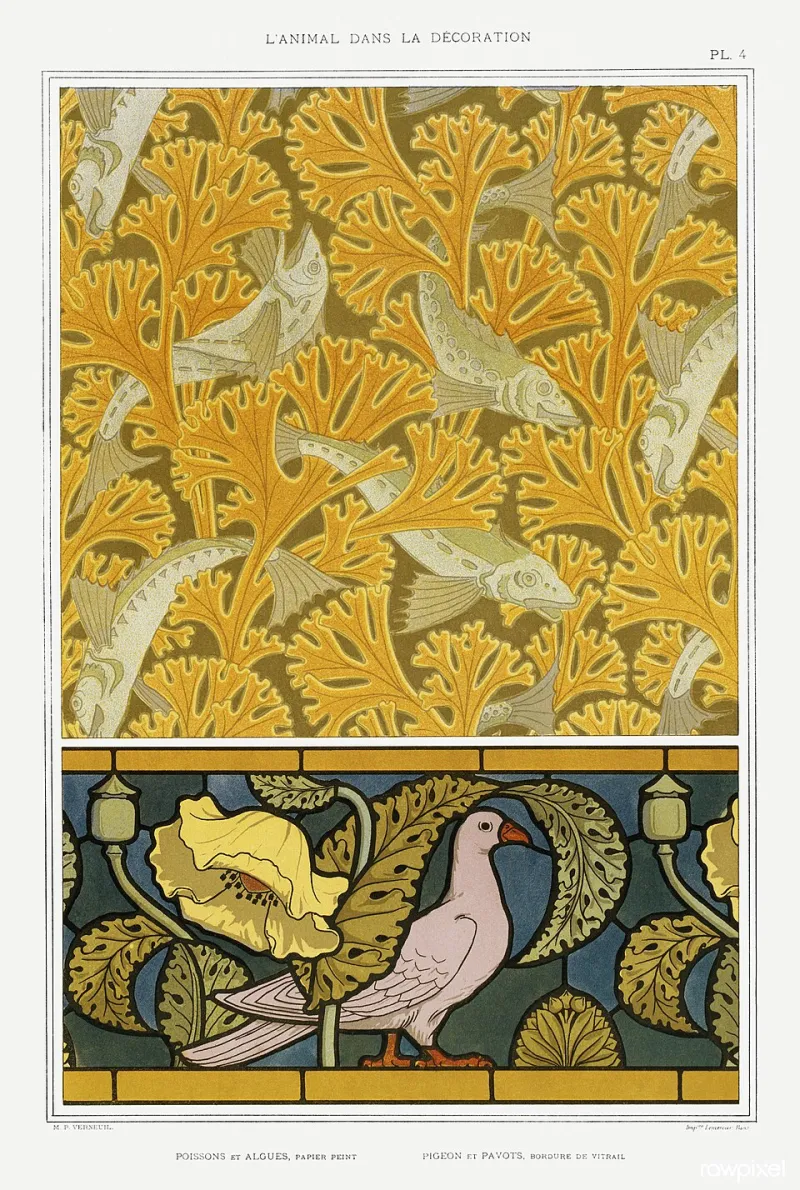
Photo: Free Public Domain Illustrations by rawpixel, CC BY 2.0, via Wikimedia Commons
A Roll in the Rafters
The loft was not, strictly speaking, part of the house I had come to inspect. It was a service space, dusty and low, lit by a single bulb and reached by a folding ladder that complained at every rung. Between the water tank and a bundle of old curtain rails lay a roll of wallpaper, partly crushed, its outer layer faded but its pattern still legible. It was not a grand discovery. It was the kind of object that is usually thrown away without ceremony, and yet it seemed to hold a small, stubborn claim on the rooms below.
A loft is often treated as the house’s unconscious. It receives what the inhabited rooms cannot accommodate: boxes of documents, tins of paint, spare tiles, lengths of timber, and the occasional remnant of a decorating scheme that once mattered enough to be kept. The roll of wallpaper was not an archive in any formal sense. It had no label, no date, no accompanying note. But it had been placed there deliberately, and that act of retention is itself a kind of evidence.
The Pattern as a Record of Taste
The paper was a repeating floral design, modest in scale, with a trellis-like ground and small clusters of leaves. It did not look expensive. It belonged to the language of mid-century domestic improvement: the sort of paper that could be bought by the roll and applied to a chimney breast or a hall, passage or bedroom, in the belief that a room might be lifted by a little pattern. In a Victorian terrace or a 1930s semi-detached house, such a paper would have had to compete with uneven plaster, damp patches and the accumulated shadows of previous schemes.
Taste is often discussed as if it were a matter of individual preference, but in domestic interiors it is usually a negotiation. It involves budget, availability, fashion and the practical limits of the room. The offcut tells us less about a person’s inner life than about the constraints under which that life was decorated. A patterned paper may have been chosen because it hid marks on the wall. A cheaper paper may have been chosen because the room was small and the budget smaller. A paper kept in the loft may have been retained because there was enough left to do a repair, or because throwing it away seemed wasteful.
Layers Beneath the Surface
In older houses, walls are rarely singular. They are composite records: plaster, lining paper, paint, filler, more paint, perhaps a patch of newer plasterboard where a doorway was moved or a chimney breast altered. To strip a wall is to disturb a sequence. The wallpaper in the loft belongs to that sequence even if it never reaches the wall again.
I have seen similar evidence in paint tins left beneath sinks and in the backs of cupboards, where a single brush mark on the lid can fix a colour to a decade. The offcut does something comparable. It gives a pattern to a period that might otherwise be recalled only vaguely. It allows one to imagine the room not as it is now, but as it was when the paper was new: the smell of paste, the temporary disorder of moved furniture, the careful matching of repeats at a corner.
Such imaginings have limits. A roll of paper cannot tell us who chose it, whether they liked it, or whether the job was done well. It cannot tell us if the room was papered in a weekend of optimistic activity or over several evenings after work. It cannot tell us whether the pattern was fashionable or merely affordable. These are precisely the questions that make domestic history difficult and worthwhile.
Photographs and the Edges of the Frame
Old family photographs often provide the natural companion to such an object. A photograph may show the paper in the background, perhaps behind a birthday table or a Christmas tree, partly obscured by a doorway or a shoulder. The pattern in the loft and the pattern in the photograph can be compared, though the comparison is rarely exact. Fading, reproduction and the angle of the camera all interfere. Yet the exercise is useful because it reminds us that photographs are not only records of people. They are records of rooms, and rooms are records of decisions.
The edges of a snapshot are often more informative than the centre. A strip of skirting, a curtain hem, a patch of wallpaper beside a light switch: these are the incidental details that survive without intention. The loft offcut is an incidental detail of the same order. It has survived because it was useful, or because it was overlooked, or because someone could not quite bring themselves to discard it.
Budgets, Aspirations and the Rooms We Inherit
When we inherit a room, we inherit more than its dimensions. We inherit its compromises. We inherit the places where the plaster was never quite flat, the door that sticks in damp weather, the fireplace that was blocked in during a previous century of improvement. We also inherit the aspirations that were expressed through decoration: the attempt to make a small front room feel larger, the wish to bring a little brightness into a north-facing kitchen, the belief that a new paper and a coat of paint might mark a fresh start.
The roll in the rafters is a modest thing, but it belongs to that history. It is not a monument to taste. It is a record of practical choice. To keep it is not to preserve a room exactly as it was, but to acknowledge that the room had a before. In an archive, such objects are often called ephemera, which is a polite word for things that were never meant to last. Yet ephemera frequently outlast grander records because they are small enough to be stored and ordinary enough to be forgotten.
The Uses of an Offcut
I do not know whether the paper will ever be used. It may be kept as a reference, or as a curiosity, or simply because it is now part of the house’s accumulated contents. Its value lies less in its pattern than in its capacity to prompt a question. What was here before? Who chose it? What were they trying to achieve? These are not questions that can be answered fully, but they are the right questions to ask of an inherited room.
A house is never only the present arrangement of its furniture. It is also a palimpsest of earlier arrangements, some visible and some stored away. The loft offcut is a small entry in that palimpsest. It reminds us that decoration is not merely surface. It is a form of domestic decision-making, shaped by money, time and hope, and it leaves traces that can outlast the hands that applied it.