Circuits in Ballpoint: What an Old Fuse Box Says About the Rooms We Have Changed
A house keeps several plans of itself. The estate agent’s particulars show the rooms as they are marketed; the title plan shows the boundaries as they are legally understood; the council tax banding shows the property as the state prefers to count it. None of these is quite the same as the plan written in ballpoint beside a row of old fuses. That small panel, often tucked under the stairs or in a cupboard beside the meter, is a working document of domestic change. It is not drawn to scale, it is rarely dated, and it is seldom consulted until something goes wrong. Yet it can be more truthful about how a house has actually been used than any floorplan prepared for a sale.
The smallest plan of the house
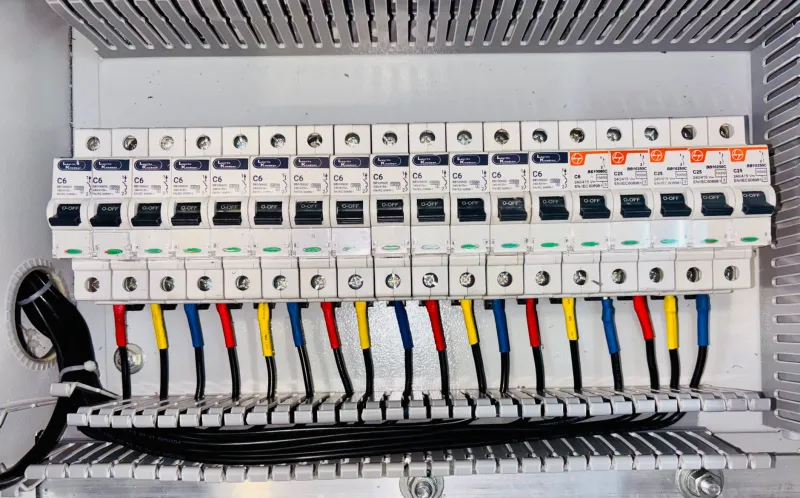
The fuse box — or, in newer installations, the consumer unit — is an unlikely archive. Its primary purpose is safety and distribution, not record-keeping. But the labels fixed beside the switches or fuse carriers are necessarily specific. They name circuits, and in naming them they name parts of the house. A label reading ‘sockets’ may seem bland until one notices that it is the only label covering three generations of extension lead, adapter and charging cable. A label reading ‘immersion’ points to a hot-water cylinder that may no longer exist, or to a backup heater that is now used only in the coldest weeks. A label reading ‘back room’ raises the obvious question: back room of what, and called what now?
These labels are usually handwritten because they were added by whoever installed or altered the circuit. They are therefore signed, in a manner of speaking, by a hand that may no longer be in the house. The slope of the letters, the pressure of the pen and the choice between capitals and lower case are small but genuine traces of occupancy. They belong to the same order of evidence as a pencil mark on a doorframe or a name written inside a cupboard door: not official, not comprehensive, but particular.
A vocabulary of use
The language of a fuse box is a language of function rather than architecture. Rooms are not usually labelled as ‘bedroom two’ or ‘dining room’; they are labelled by what draws power. ‘Lights’, ‘sockets’, ‘cooker’, ‘shower’, ‘garage’, ‘shed’, ‘alarm’. This is a vocabulary of use, and use changes faster than brickwork. A room may remain the same shape for a century while its electrical identity changes completely. The ‘back room’ may have been a scullery, then a utility room, then a study, then a makeshift bedroom, then a study again. The label stays put, a fossil of an earlier arrangement.
In this sense the fuse box resembles an index rather than a map. It does not tell you where the walls are, but it tells you what the house has been asked to do. The presence of a separate circuit for an immersion heater, for example, may indicate a period when hot water was stored and timed rather than produced on demand. A dedicated cooker circuit may point to a change in kitchen equipment, from a free-standing gas appliance to an electric range. A label for a garage or outbuilding may be the only remaining paperwork for a structure that has since been demolished, or for one that was built without much ceremony and never entered the deeds.
Renaming and forgetting
Rooms are renamed quietly. A ‘front room’ becomes a ‘lounge’, then a ‘living room’, then perhaps a ‘snug’ in an estate agent’s copy. A ‘back kitchen’ becomes a ‘utility’. A ‘box room’ becomes a ‘study’ when it acquires a desk and a broadband router. The fuse box rarely keeps up. Its labels preserve an older nomenclature, and that lag is useful. It shows that domestic space is not simply occupied but continually reinterpreted. The house is not a fixed container into which life is poured; it is a set of rooms that are argued over, repurposed and renamed by the people who live in them.
There is also forgetting. Appliances vanish: the chest freezer, the night storage heater, the tumble dryer that lived in the outhouse. Their circuits may remain, disconnected or merely unused, with labels pointing to nothing. These orphaned labels are a reminder that a house’s electrical system accumulates rather than replaces. Old wiring is not always removed; it is often isolated, left in place, and quietly superseded. The fuse box becomes a palimpsest, with newer arrangements written over older ones.
Handwriting as occupancy
The handwriting itself matters. A printed label is a small act of standardisation; a handwritten one is a small act of testimony. It may have been written by an electrician, a landlord, a previous owner or a competent amateur. In older installations, the distinction is not always clear. The labels may be neatly ruled or hastily scribbled; they may use trade abbreviations or household shorthand. Either way, they record a moment when someone stood in front of the board, understood its arrangement, and tried to make it legible to others.
That moment is not neutral. It reflects a particular version of the house. The person writing ‘sockets’ may have known perfectly well that the circuit served only the front two rooms; the person reading it twenty years later may assume it serves all of them. The label is a summary, and summaries omit. This is why the fuse box should be read with the same caution as any archive: not as a complete record, but as a partial one, shaped by the knowledge and habits of its maker.
What the plan cannot certify
It is important not to overstate the evidence. A fuse box is not a building survey, and its labels are not a guarantee of safe or compliant wiring. Electrical installations should be inspected and tested by a qualified professional, particularly in older properties where circuits may have been altered incrementally. The archive value of the labels is separate from their technical authority. They tell us something about use and change; they do not certify that the installation is sound.
Nor do they tell us who lived with the arrangements. A label can record a circuit but not the person who relied on it. It cannot show the winter morning when the immersion heater failed, or the argument about leaving the storage heater on, or the child who was told not to touch the board. Those are the kinds of history that live in memory and correspondence, not in the fuse box itself. The labels are prompts, not conclusions.
A modest method
For anyone keeping a domestic archive, the fuse box deserves a photograph and a short note. Record the labels as they are, before any alteration. Note the date of the photograph and, if known, the approximate age of the installation. Do not remove or deface the labels in the interests of tidiness; their inconsistencies are part of the evidence. If a qualified electrician is updating the board, ask whether the old labels can be photographed first. The new consumer unit may be safer and more legible, but it will also be cleaner, and cleanliness is not the same as memory.
The fuse box knows a version of the house that the floorplan does not. It knows the back room before it was renamed, the immersion heater before the combi boiler, the garage before it became a studio. It is a small, awkward, handwritten map of domestic life, and it is worth reading while it is still there.